


If you’re looking at a light’s PPE, chances are you are looking for a good deal. You want to know that the light can emit a ton of photons while using very little energy, because less energy used means more money saved. But does a better PPE actually mean more bang for your buck? Well, that’s a tricky question…
PPE, or Photosynthetic Photon Efficacy, measures how well a light fixture converts electrical energy into PAR light (the wavelength range of light plants need to achieve photosynthesis). Essentially, efficacy is a lights PPF/ watts used per second, but it’s expressed as the formula umol/J or micromoles of light per joule of energy used. The better a light’s PPE, the more photons it emits per watt, so a better PPE should mean less money spent per plant… but in practice, that can vary.
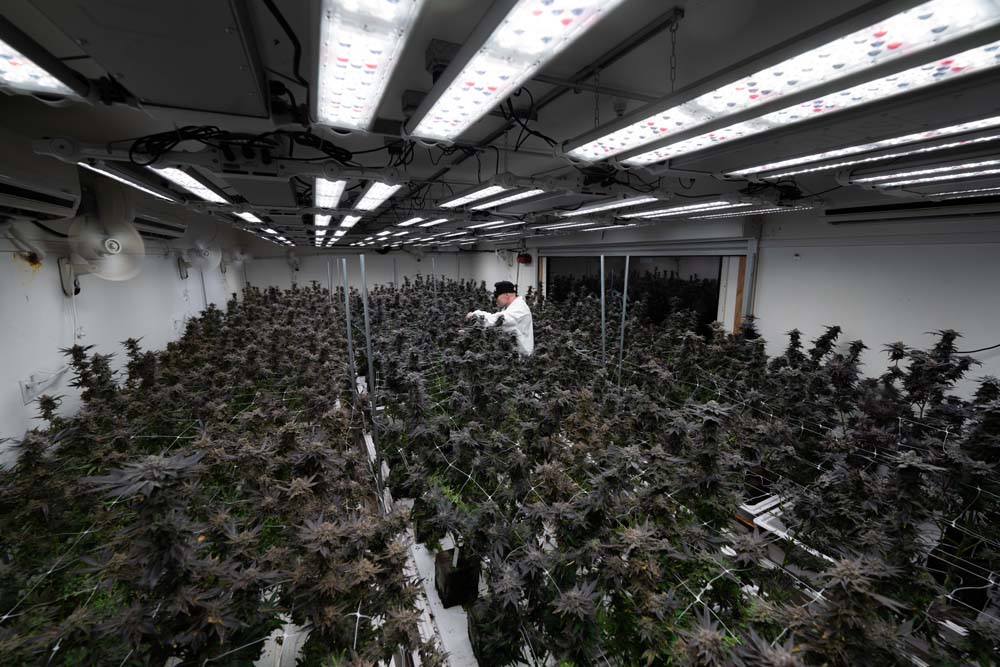
Now, the goal of horticultural lighting is not to emit as much light as possible, but to deliver as much light as possible to the surface of a plant. Since PPF is a measure of light being emitted, not light landing on a plant, it can seem confusing when growers buy a light with a good photosynthetic photon flux and find that the light it’s emitting is getting lost. That’s because the PPF of a light doesn’t always translate to a better PPFD, the measurement of the number of photons on a plant’s surface.
So if the goal is to get light to the plant, what are some ways to increase the light reaching the plant?
ADD MORE POWER
By increasing the power, you increase the intensity of the light and the amount of photons being emitted, raising the PPF. Unfortunately, it comes at the cost of more energy used, which means more money spent, and a shorter lifespan on your light. Running a fixture at or near maximum output lowers its overall efficiency and reduces its lifespan. Similar to a car, a light lasts longer when it’s used with care, and running it that hot will burn it out much faster. But what if you’re already running the light at full power?
CHASING CANOPY
Moving the light closer to the canopy of the plant will also increase the amount of photons it receives exponentially. According to the inverse square law, when you decrease the distance from your light to the plant, you increase the amount of light it receives by the square of the distance. Halve the distance, and you’ve quadrupled the amount of light. But, as the plant grows, the light will need to be adjusted to keep the plant from growing into the fixture. And, as it moves away from the plant and that distance increases, the amount of light will decrease exponentially. If you double the distance, the light reaching the surface will be ¼ what it once was. With the inverse square law, the sword cuts both ways. In large commercial operations, the practice of ‘chasing canopy’ is a labor nightmare. Making constant height adjustments is no trouble when there are a few fixtures involved, but imagine the logistical challenge of doing this with hundreds or thousands of fixtures every week!
REDIRECT THE LIGHT
Another way to supply the plant with more light is to redirect the light that is not hitting the plant. You can do that by applying reflective surfaces to your walls, but there’s a way to handle it at the light source through the clever manipulation of the optics.
The primary optic in an LED is the diode, a tiny chip that emits light that’s coated in silicone. These diodes are mounted on a flat reflective surface, so they are only emitting their photons at an angle of 180º, meaning that light is being emitted left, right and center. This angle is already better than a typical light bulb, which sends light in 360 degrees, however, when that light is hung above a plant, the photons going left and right won’t land on the leaf’s surface.
By applying a secondary optic, like a lens, the angle of the light emitted can be decreased, and any light that was once going straight out to the left and right is now being redirected to the center, adding its photons to the whole. Now, adding this lens reduces the amount of photons that are being emitted by the lamp by a tiny amount, decreasing the PPF of the light and, in turn, the PPE. However, the light that was not hitting the plants will be redirected, increasing the PPFD of the plant by a substantial amount. Despite the negligible loss at the lens, the overall efficacy of photons delivered to the canopy is dramatically higher than a fixture with no lens whatsoever.
MAKING MONEY MOVES
These are questions every grower must consider: Is it more important to have a light operating with a good PPE, even if it means less photons getting to their plants. Can they afford the labor that comes with racking and re-racking every lighting fixture they own, or will they be able to cover the energy bill that follows running their lights at maximum output? It’s no surprise that cost is a huge factor, and one that often leads growers to High-Pressure Sodium lighting.
Initial costs for HPS lighting are always lower than LED, and why wouldn’t they be? These are the same lights that are used for old street lamps. A double-ended 1,000W HPS lamp with an electronic ballast has a PPE of around 1.7 µmol·J–1, while the value for top of the line LED fixtures can exceed 2.0 µmol·J–1. According to Prof. Erik Runkle from the department of horticulture at Michigan State University, “upgrading to modern lighting technology can reduce electric cost by more than 50 percent.” Growers who operate lamps for more than 4 months of the year (2,000 hours or more) and whose electricity prices are above average ($0.12 kWh) could realize payback in two to three years.” {https://www.canr.msu.edu/floriculture/uploads/files/lighting-efficacy.pdf}
KEY TAKEAWAYS
Not all lights are made the same. Even LEDs. PPE can be manipulated in a myriad of ways. A manufacturer could make LEDs with only red diodes, which use less energy and still emit photons in the PAR zone. While the light would have a good PPE rating and PPF, the absence of any other colors means that the plant won’t receive the full range of photons it needs in order to grow, flower, and propagate.
It’s important to have a light that is efficacious in terms of industry standards, but the light should also be efficacious for the plant. Not only does the light need to supply a range of photons, but it must be sent towards a specific area. A high PPE doesn’t mean your plant is receiving all of the photons that the light is emitting, so you might not be benefitting from a particularly efficacious light. Yes, it is important to know how many photons your lighting fixture is capable of sending out, but you should also keep an eye on the quality of the light, and where that light is going once it’s emitted, because that’s where you’ll find the bang for your buck. Afterall, the whole point is to deliver as much light as possible to your canopy with the lowest amount of inputs. That’s the name of the game.


